

For many parents, the biggest concern after an autism diagnosis is simple and practical:
How will my child manage everyday life?
Daily activities such as communicating needs, interacting with others, or completing routine tasks can be difficult for children on the autism spectrum. That is where ABA therapy for children with autism often becomes an important support system.
Applied Behavior Analysis has been used for decades to help children develop communication, learning, and independence skills. Rather than focusing only on academic progress, ABA focuses on behaviors that help children function better in daily life.
At Infinity Counseling Group, we provide compassionate, individualized ABA therapy in Norfolk designed to help children build meaningful life skills while supporting parents every step of the way.
What Parents Should Know About ABA Therapy for Children With Autism
Applied Behavior Analysis therapy for children is a structured, evidence-based approach that studies how behavior works and how learning happens. Therapists use these particulars to teach new skills and reduce behaviors that interfere with everyday functioning.
The therapy is highly individualized. An ABA therapy program commonly begins with an assessment conducted by a behavior analyst. The clinician observes how the child learns, communicates, and responds to their environment. Based on this evaluation, a personalized plan is created.
According to Autism Speaks, ABA uses behavioral science to increase helpful behaviors while decreasing those that interfere with learning or safety. The therapy has been widely studied and used for autism since the 1960s.
The goal is not to change a child’s personality. Instead, ABA focuses on helping children gain skills that improve their capability to navigate daily life.
Key Benefits of ABA Therapy for Children With Autism
One reason ABA for children is widely recommended is its ability to address multiple developmental areas at once. The therapy targets behavior, communication, and social skills simultaneously.
Research shows that comprehensive ABA-based interventions can lead to measurable improvements in intellectual functioning and adaptive behavior among children with autism.
Some of the most recognized benefits of ABA include:
- Improved communication skills
- Better emotional regulation
- Reduced challenging behaviors
- Increased independence in daily routines
- Improved attention and learning ability
For many families, the most noticeable change is how everyday situations become easier for the child.
Improving Communication and ABA Social Skills
Communication challenges are common for children on the autism spectrum. Some children may struggle to express needs, while others may find social interactions confusing.
ABA social skills training helps children practice real-life communication scenarios in a structured way.
For example, therapists may work on:
- Asking for help
- Taking turns in conversation
- Responding to questions
- Understanding facial expressions
- Participating in group activities
Through repeated practice and positive reinforcement, children gradually become more comfortable interacting with others.
Studies have found that ABA therapy social skills training often leads to improvements in language development and peer interaction.
ABA Skills That Support Everyday Living
While communication and behavior are important, many parents are equally concerned about practical independence.
That is where ABA skills training focuses on daily routines that help children function independently.
These may include:
- Dressing independently
- Brushing teeth
- Following classroom instructions
- Eating with utensils
- Managing transitions between activities
Therapists often break complex activities into small, manageable steps. Over time, children learn to perform these tasks with less support.
This process is sometimes referred to as adaptive behavior analysis because the goal is to improve behaviors that help children adapt to everyday environments.
Applied Behavior Analysis Techniques Used in Therapy
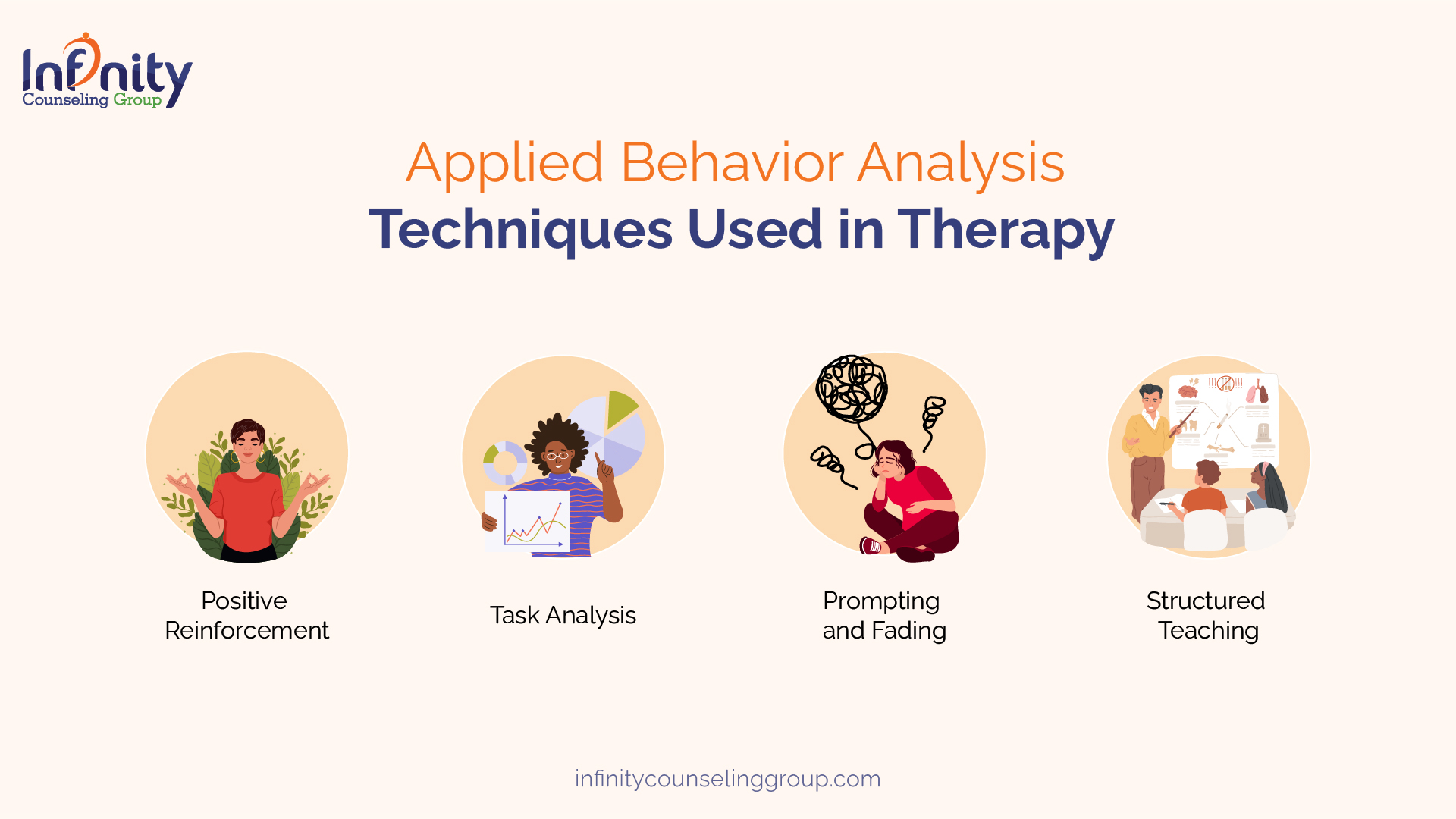
The success of ABA in autism therapy comes from a set of carefully designed teaching methods. These applied behavior analysis techniques are based on how people learn new behaviors.
Some of the most commonly used methods include:
Positive Reinforcement
When a child successfully performs a desired behavior, they receive a reward such as praise, a toy, or a preferred activity. This increases the likelihood that the behavior will happen again.
Task Analysis
A complex skill is broken into smaller steps. For example, brushing teeth may be divided into several simple actions.
Prompting and Fading
The therapist provides cues to help the child complete a task, then gradually reduces assistance as the child learns.
Structured Teaching
Some ABA sessions use structured learning formats such as discrete trial training (DTT) or natural learning methods like pivotal response training (PRT).
These strategies make learning clearer and more predictable for children with autism.
Personalizing an ABA Therapy Program for Each Child
No two children with autism are the same. That is why ABA therapy for autistic children always begins with individualized planning.
A behavior analyst evaluates:
- Communication ability
- Cognitive skills
- Social interaction patterns
- Behavior triggers
- Learning preferences
Based on this information, therapists design a customized ABA therapy program that targets the child’s specific developmental goals.
In many cases, parents are also involved in ABA therapy for autism training, learning strategies they can use at home to reinforce new skills.
This collaborative approach helps children practice what they learn across different environments.
Long-Term Impact of ABA Therapy on Daily Skills
One of the reasons ABA therapy for children is so widely used is its long-term impact.
Studies suggest that children receiving consistent ABA interventions show improvements in adaptive behavior, communication, and social interaction.
Over time, these skills can translate into meaningful life outcomes, such as:
- Greater independence
- Improved academic performance
- Better social relationships
- Increased confidence
Some research also indicates that early ABA interventions can support long-term adaptive functioning and independence into adulthood.
When Should a Child Start ABA Therapy?
Early intervention is often recommended when autism symptoms are identified.
Many specialists suggest starting ABA therapy for children with autism during early childhood, sometimes as young as two or three years old. However, older children and even teenagers can benefit from ABA services for children as well.
The key factor is consistency. Therapy sessions may range from a few hours per week to intensive programs, depending on the child’s needs.
Families searching for autism therapy for children often begin by consulting behavioral specialists who can recommend an appropriate treatment plan.
Conclusion
Every child learns in their own way. For children on the autism spectrum, the right support can make daily life more manageable and empowering.
At Infinity Counseling Group, structured ABA programs are designed to help children build communication, independence, and practical life skills in supportive environments.
If you are exploring ABA therapy for children with autism, speaking with a qualified specialist can help you understand whether this approach fits your child’s needs.
Contact Infinity Counseling Group today to learn more about personalized ABA services and how early intervention can support your child’s development.
FAQs
Progress varies depending on the child and the intensity of therapy. Some families begin noticing small improvements within a few months, while larger skill development may take longer.
Although ABA for children is most commonly used for autism, the behavioral principles can support individuals with other developmental or learning challenges as well.
Programs may range from 5 to 40 hours per week, depending on the child’s developmental needs and treatment goals.
ABA therapy often focuses on communication, self-care routines, social interaction, classroom behavior, and emotional regulation.